
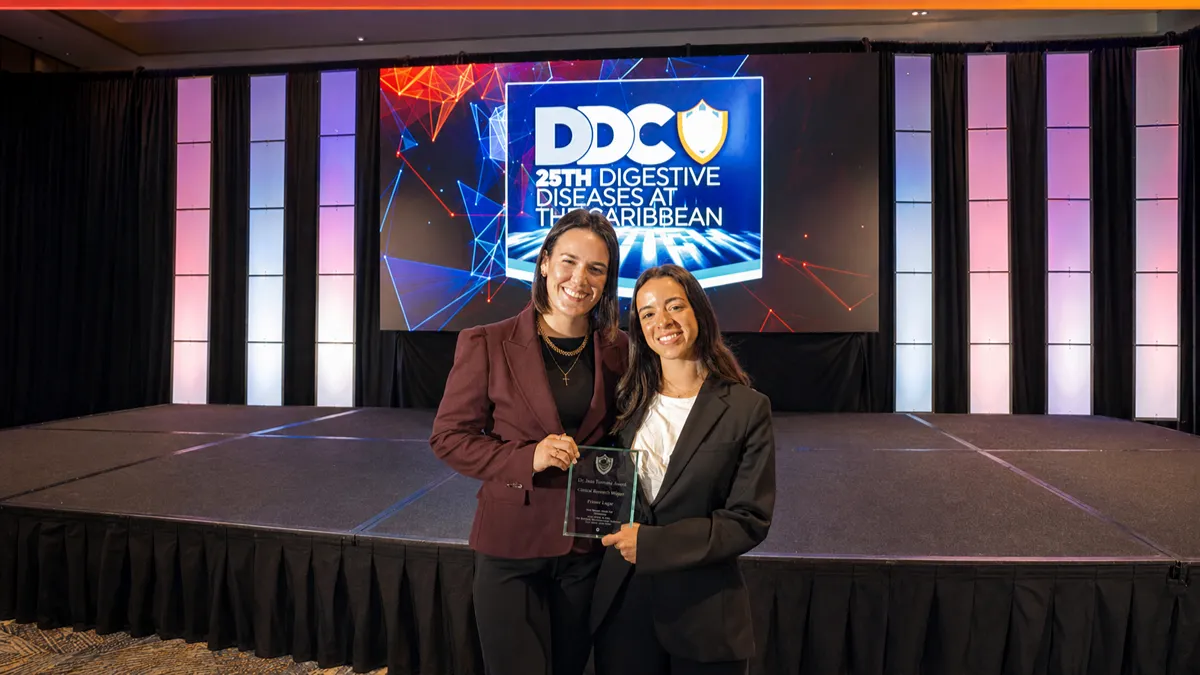
Researchers Katia Villafañe and María V. Hayes, students in PanOncology Research Foundation’s Pan-Rex Program, won First Place in the Poster Presentation category at the Digestive Diseases of the Caribbean (DDC) 2026 congress, held March 5–8, 2026, at the Sheraton Convention Center.
This year’s congress, titled “Advances and Innovation: Beyond Guidelines,” brings together digestive disease specialists from Puerto Rico and the Caribbean each year to discuss the latest advances in diagnosis, treatment, and research.
The award-winning research, titled “Prevalence of Germline and Somatic Pathogenic Variants in Patients with Pancreatic Cancer in Puerto Rico, 2020–2025,” was selected for poster presentation at the congress. Along with first place, the distinction earned the researchers the opportunity to present their findings orally to attendees, in a session reserved for the work of greatest scientific merit.
The study examines the prevalence of germline and somatic pathogenic variants in patients diagnosed with pancreatic cancer in Puerto Rico over a five-year period. Germline variants are inherited genetic alterations that can increase the risk of developing cancer and carry implications for the patient’s relatives; somatic variants are alterations that arise in the tumor over the course of a lifetime and can guide the selection of targeted therapies. Characterizing both types of variants in the Puerto Rican population is a necessary step toward developing early detection strategies, genetic counseling, and treatment approaches adapted to the Island’s particular profile.
Pancreatic cancer carries one of the poorest prognoses, largely because it is usually diagnosed at advanced stages. Identifying pathogenic variants in patients and their families opens the door to surveillance programs for high-risk individuals, as well as the use of therapies matched to specific molecular profiles. In Hispanic and Caribbean populations, however, the available evidence is limited, since most genomic studies have been conducted in populations of European ancestry. Work like this helps close that gap.
PanOncology Research Foundation’s Pan-Rex Program trains students in oncology research through direct participation in scientific projects, mentored by the institution’s researchers and clinicians. The recognition received at DDC 2026 highlights both the scientific excellence of the work and the researchers’ commitment to advancing knowledge about pancreatic cancer in Puerto Rico.
“The Pan-Rex Program exists to enable students to take research from theory to practice—formulating questions, analyzing data, and defending their findings. The fact that Katia and María took first place and were invited to present their work orally confirms that this model works. Furthermore, their study addresses a real gap: we have very little genomic information regarding pancreatic cancer in Hispanic and Caribbean populations, and this work provides evidence generated right here, based on our own patients.”
Luzeida Vargas, MD, Grant and Research Director, PanOncology Research Foundation
The Foundation congratulates Katia Villafañe and María V. Hayes on this achievement and reaffirms its commitment to training researchers and generating scientific evidence that responds to the needs of patients in Puerto Rico.